

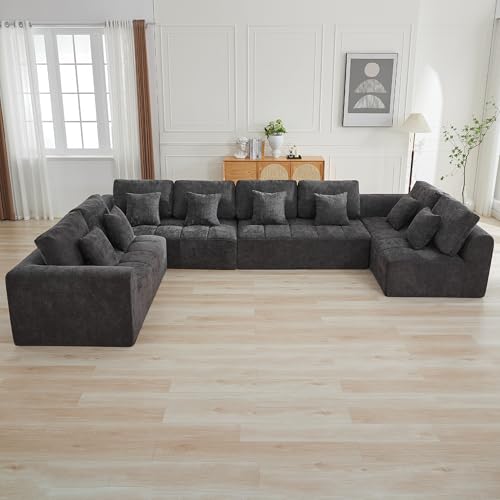

The complete boneless couch buyer's guide
Boneless couches went from a TikTok curiosity to one of Amazon's fastest-growing furniture categories in 18 months — and the category is now flooded with near-identical foam-block listings at wildly varying quality. The picks above are the rare options that meet the foam-density bar and survive past the 12-month mark. Here's the buying logic.
Are boneless couches actually comfortable?
For casual lounging — TV nights, movie marathons, reading, kids' play — yes, the cloud-pile sit-feel is genuinely comfortable and a meaningful upgrade over a stiff framed sofa. For 8-hour daily seating (working from the couch, daily back support, formal seated dinners), no — the foam-block construction lacks the structural lumbar support of a framed piece. Buy a boneless couch for the use case it's designed for, not as a daily desk substitute.
How long do boneless couches actually last?
With HR foam (1.8+ lb/cu ft, all picks above), expect 3-5 years of normal use before noticeable foam compression. Sub-$400 listings with lower-density foam typically fail at 12-18 months. Rotating your seating spot (don't always sit in the same cushion) and removing/washing covers periodically extends usable life. Compare to 10-15 years for a quality framed sofa — boneless wins on price-per-year only if you replace at the 5-year mark vs maintaining a framed piece for 15.
Why are boneless couches so much cheaper than traditional sectionals?
Three reasons: (1) no internal wood/metal frame to manufacture and ship, (2) compressed shipping (a 110" sectional fits in two cartons through a standard doorway, eliminating the white-glove delivery cost a framed sofa requires), (3) modular foam-block construction is faster to manufacture than upholstered framed seating. The trade-offs (durability, structural support, longevity) are real — but for the right use case, the price-per-year math works out.
Do boneless couches need a wall to lean against?
Most fully-boneless designs (no internal structural support whatsoever) do benefit from a wall behind the back cushions to prevent slow forward slumping. The picks on this list with deep modular construction maintain shape standalone, but if your floor plan requires the couch to float in the middle of a room, look specifically for models with an internal metal bracket frame (more rigid than fully boneless, slightly firmer sit-feel as a trade-off).
How does the no-assembly delivery actually work?
Boneless couches ship vacuum-compressed in cardboard cartons sized to fit through a standard 32-inch doorway. Once you cut the outer plastic wrap, the foam blocks expand on their own — most reach 90% of final shape within 24 hours and full shape within 48-72 hours. No tools, no hardware, no assembly instructions needed. Important: position the couch in its final spot before cutting the packaging, because moving it after expansion is significantly harder than dragging the boxed components into place.
What about the "rearrange into any shape" TikTok pitch — is it real?
Real, but with asterisks. Truly modular options (170" foam-block sectionals) genuinely let you pick up and rearrange foam sections without tools — that's the appeal. Fixed L-shape boneless couches do NOT rearrange — "modular" in those listings just means the cover comes off. If rearrangeability is a requirement, verify the listing specifies "modular foam blocks" or "rearrangeable configuration" explicitly. The foam-block connectors do loosen with frequent reconfigurations, so plan for periodic re-tightening of the interior straps.
Can the covers actually be washed?
Yes for all picks above — zippered removable covers, machine-wash cold on gentle cycle, air-dry (do not tumble dry, the polyester blends shrink). Spot-cleaning with upholstery cleaner handles 90% of daily stains without full cover removal. The fact that covers are washable is a meaningful long-term advantage over framed sofas with non-removable upholstery, which require professional cleaning at $200-400 per session.